Tuesday, April 25, 2017

Is it Worth Fighting Invasive Species?


Emerald ash borer larva
I've often asked myself that very question.  Each year I get out and treat invasive plants on our demonstration woodlot.  I often ask myself is this worth it?  Am I making a difference?  Should I keep doing this?  The answer I keep coming up with is a is a resounding YES!  I know we won't eradicate these plant and insect invaders but at least I know my efforts will keep them at bay, keep them from completely taking over the woodlot.

We know invasive species are here to stay.  They live in most, if not all, ecosystems.  But what are we to do about them?  Should we invest time and resources elsewhere?  A new video entitled Invasive Species - Fight 'em or Throw in the Towel by Untamed Science tries to answer this question.  Is it even worth fighting invasive species?

Tuesday, April 11, 2017

Now is the Time to Destroy Spotted Lanternfly Eggs and Report Your Efforts


The spotted lanternfly, Lycorma delicatula, now found in portions of 5 counties in SE Pennsyllvania (Berks, Bucks, Chester, Lehigh, and Montgomery) lays egg masses of 30-50 eggs wherever there's a flat surface. Any smooth-trunked tree, stone, or vertical smooth surface can provide a potential host for eggs masses. Man-made items like vehicles, campers, yard furniture, or any other items stored outside and easily transported, are suitable sites for egg laying and help it spread quickly.

Therefore, a general quarantine over any area found to harbor the spotted lanternfly means that any material or object that can spread the pest cannot be moved. For the most current quarantine information visit the Pennsylvania Department of Agriculture's Spotted Lanternfly site.

People can reduce the populations of spotted lanternfly on their properties by killing the overwintering eggs. Residents of the infested area are encouraged to inspect their trees and other objects for spotted lanternfly egg masses, and destroy them before they hatch.  Experts expect the eggs will start to hatch in early May, so late March through April is a great time to do this.

Monday, April 3, 2017

Epidemic Effecting Landscape Trees

I saw it just today, landscape crews hard at work mulching trees, or should I say over-mulching trees.  Mulch is piled against the trunk of the tree rather than spread out in a thin layer.  This method of mulching, often referred to as "volcano" mulching slowly impacts tree health and vigor.  Trees would be much better off having the same amount of mulch spread out across a larger area.  This would promote proper root growth and tree vigor.  Below is a news release from one of my colleagues Vinnie Cotrone, Extension Urban Forester, addressing this issue.

Epidemic Effecting Landscape Trees 
There is an epidemic spreading throughout the state and country that is slowly killing trees and shrubs in our landscapes.  No, it isn’t another disease or insect we accidentally imported from another country like Asian Longhorned Beetle which is killing trees in NYC and Chicago or Dutch Elm Disease which changed our landscapes in the 1960’s and 70’s.  And unlike some of these imported pests, this epidemic can be prevented very easily.

Don't over-mulch and create mulch "volcanoes!"
This epidemic is caused by misapplication of mulch around our trees and shrubs.  “We are over-mulching our trees and shrubs to death” says Vincent Cotrone, Penn State Urban Forester and certified arborist.  “Mulching is a terrific way to add organic matter and nutrients, conserve soil moisture, and prevent lawn mowers from injuring trees and shrubs, but it is just being put on way too thick and piled too high on trunks and stems.” 
           
When mulches are put on too thick and piled against the stems of trees and shrubs, they begin to suffocate roots and create a moist environment in which opportunistic decay fungi such as Phytophora, Armillaria, and Leptographium attack the trunk and roots, causing root rots, a decline in plant health, crown dieback, and tree failures.  Besides causing the roots and stems to rot, over-mulching prevents the movement of oxygen and carbon dioxide in and out of stems; can lead to rodent chewing and stem girdling; nutrient deficiencies and the production of toxic organic acids; and often causes roots to grow up into thick mulch, only to dry out in hot summers, or form girdling roots that encircle and the trunk.
           
“It seems to be fashionable these days for landscapers and homeowners to create these mountainous mulch “volcanoes” at the base of trees” says Cotrone.  “Unfortunately this continues because there is a lack of knowledge about how trees really grow and the harm caused by this practice.”  A quick walk in the woods will illustrate how trees have a natural flare where their trunks meet the soil (visible even on young trees).  “It is important that we not cover that flare with soil or mulch” says Cotrone.  “Spread the mulch out in a layer that is no thicker than 3-4 inches, and don’t pile it up on the trunks of trees and stems of shrubs”. 
           
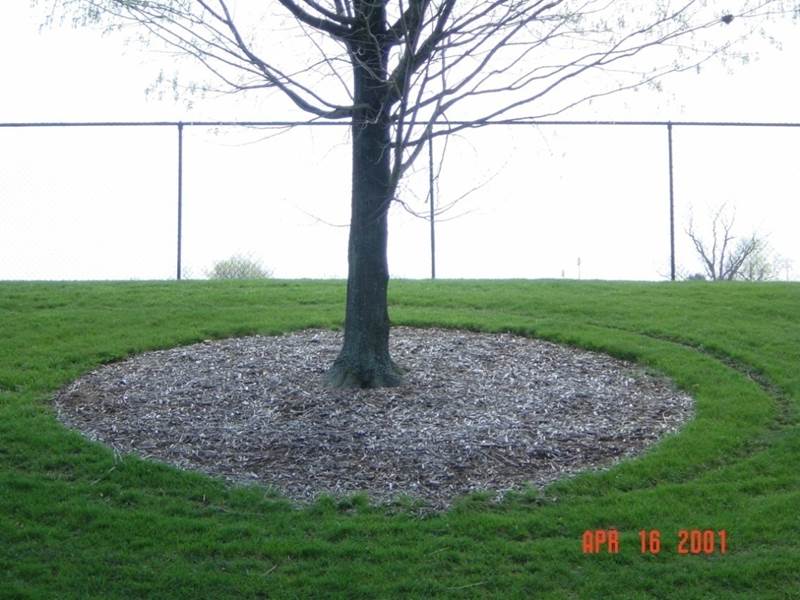
A properly mulched tree!
Mulching your trees and shrubs can improve soils and grow healthy plants, but too much of a good thing can be harmful.  So take a closer look at your mulch or your landscapers work this summer and make sure you don’t have mulch-mountains or “volcanoes” in your landscape.  Let’s stop this epidemic before it kills more trees.

For more information on mulching visit the following websites:
Penn State Extension: Planting Ornamentals

Trees Are Good: Proper Mulching Techniques

Tuesday, March 14, 2017

Pennsylvania Forest Landowner Conference


After a long silence during the recent recession when the demand for hardwood lumber tanked, the log trucks are rolling again. Loads of beautiful American white ash are being salvaged, unfortunate victims of the emerald ash borer. Ash wood is white and quite dense, strong, and straight-grained. It’s been the timber of choice for baseball bats and tool handles; it makes good furniture and flooring. We hate to see the woodpeckers working on its bark and to see it disappear from our woods.

I’d like to suggest to folks who have sold their ash trees that they use this as an opportunity to think about the future of their woods. What can you do now to insure that at least part of that resource is still there for you? Would you like to use this opportunity to manage your woods as a future/different timber resource, or for firewood, for wildlife or deer, or especially for your children or grand kids? If so, plan to investigate the upcoming statewide Penn State Forest Landowners Conference: Enriching Woodland Values.

Held in Altoona’s Blair County Convention Center March 24 and 25, it’s a biennial (every two years) gathering of woodland owners from across the state and beyond, with a phenomenal set of professional presenters and a wide array of topics. Attendees are sure to find something that interests them: select from nearly 100 presentations, multiple field tours, extended-learning workshops, a full hall of exhibitors, and perhaps best of all, time to compare notes with other landowners and the opportunity to corner the experts with your personal questions.

It may seem a long way to Altoona, PA, but it is right down I-99. Get a car-load together, take your family, assemble your hunting buddies, grab a neighbor. The trip will be worth every penny when you come back and look at your own woods with new eyes, understanding, and intention. We’ve extracted the value of ash, now it’s time to put some value back into our woods. Pennsylvania holds the most valuable hardwood resource in the United States, and you are the steward for your part of it.

There is still time to register: You can register online through today, March 14; telephone registrations will be taken through next Monday, March 20, by calling 1-877-778-2937; and after that walk-ins will be accepted at the Convention Center.

Nancy Baker
3-13-17